

Step-by-Step Guide: Setting Up a Secure Business Email (name@yourdomain.com) on Cloud Hosting
Key Authentication Protocols for Maximum Deliverability
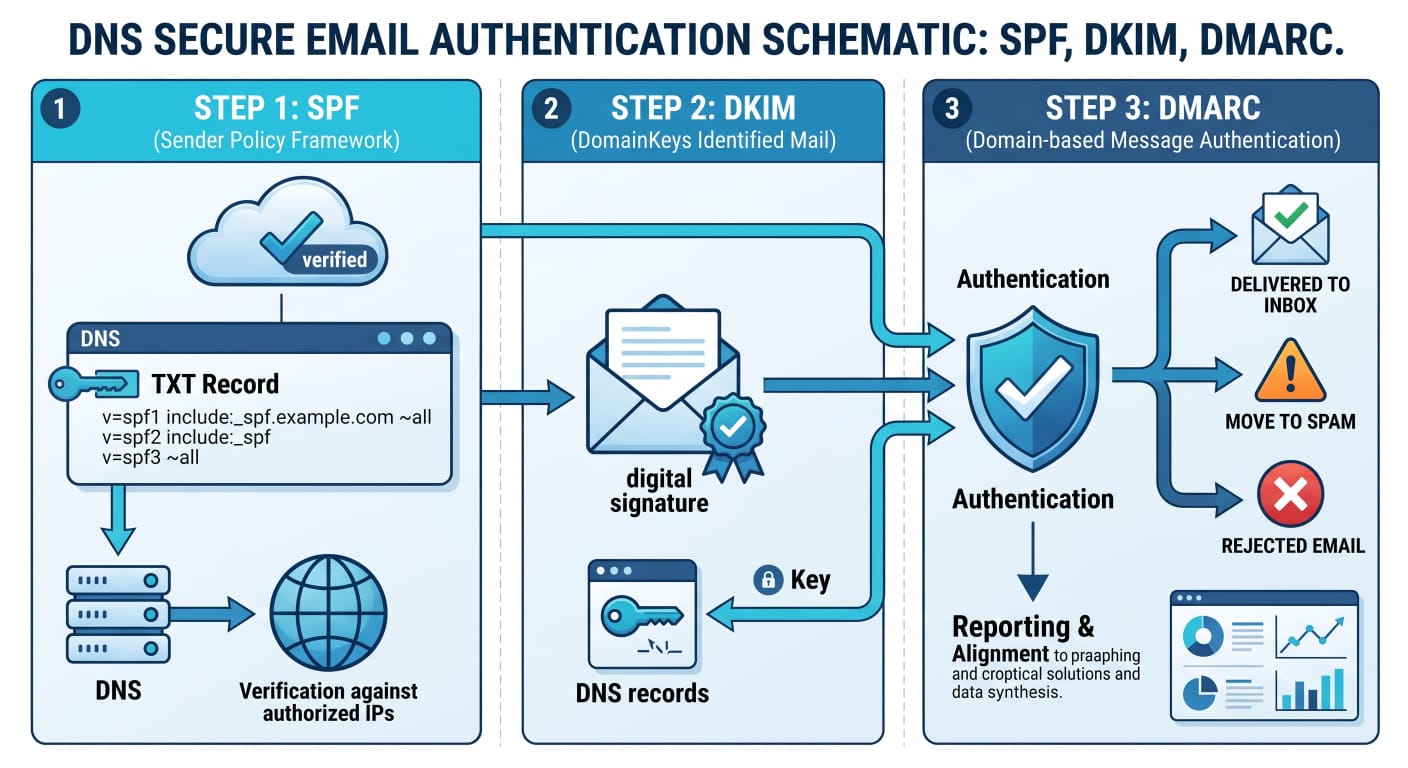
The primary concern for any company setting up a new email server on the cloud is deliverability. Sending corporate emails directly from a cloud server IP address without proper DNS configuration often results in messages landing straight into recipient Spam or Junk folders. JPGTo prevent this, system administrators must configure essential email authentication protocols immediately:
- SPF (Sender Policy Framework): Publishes a public list of authorized server IP addresses permitted to send emails on behalf of your domain.
- DKIM (DomainKeys Identified Mail): Adds a digital cryptographic signature to every outgoing message, verifying that the email was genuinely sent by your organization and was not altered in transit.
- DMARC (Domain-based Message Authentication, Reporting, and Conformance): Ties SPF and DKIM together, giving domain owners strict policy control over how receiving mail servers handle unauthenticated messages.
When businesses transition from free webmail services like Gmail or Yahoo to a professional
custom domain email, finding the right hosting infrastructure is the first critical step.
professional business email address (such as info@yourcompany.com) builds immediate trust
with customers, partners, and financial institutions. However, many website owners struggle to
understand how email hosting integrates with cloud hosting environments. Unlike basic shared
hosting where email and website files share identical, congested resources, cloud hosting
allows businesses to configure dedicated mail servers, optimize delivery rates, and protect
corporate communications from cyber threats.
Storage Scalability and Mailbox Control
Another major advantage of running business email on a cloud hosting server is storage scalability and mailbox control.
Free email providers limit your storage capacity, forcing you to delete important client correspondence or pay ongoing monthly fees per user.
With a cloud hosting solution from 99 Cloud Tech, you retain full administrative control over mailbox quotas. You can create unlimited email accounts corresponding to different departments—such as sales@, support@, and billing@—while allocating precise gigabytes of storage to each user.
Conclusion: Elevating Your Brand with Secure Email Hosting
Transitioning your corporate communication to a dedicated cloud hosting infrastructure is more than just a technical upgrade—it is a strategic investment in your brand’s security, credibility, and operational efficiency. By properly configuring essential DNS protocols like SPF, DKIM, and DMARC, you protect your domain reputation, eliminate spam risks, and guarantee that critical emails reach your clients’ inboxes reliably.
With full control over storage scalability, robust mail server security, and seamless multi-device integration, cloud email hosting provides the solid foundation your business needs to grow with confidence.
Advanced Security & Spam Protection From Mailboxes
Security is another critical pillar of cloud-based email management. Corporate mailboxes frequently targeted by phishing attacks, ransomware, and brute-force login attempts require robust protection.
Cloud servers allow the installation of advanced mail transfer agents (MTAs) like Postfix and Dovecot, combined with spam filtering engines like SpamAssassin and ClamAV antivirus scanners.
These tools scan incoming attachments and headers in real-time, blocking malicious payloads before they reach employee inboxes. Additionally, enforcing SSL/TLS encryption for all incoming and outgoing mail ports guarantees that internal corporate discussions and sensitive customer data remain completely encrypted and secure from packet sniffers.